
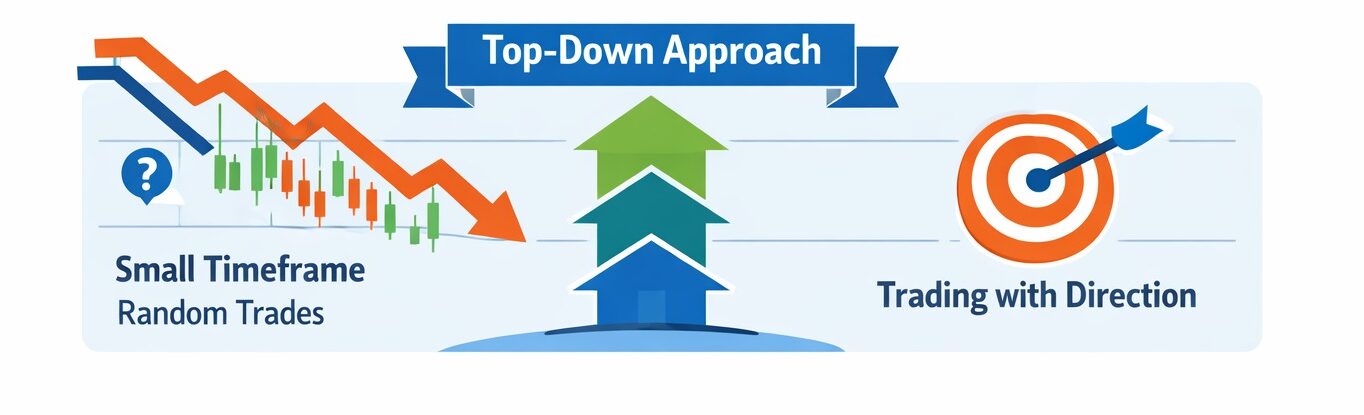
Many traders enter the market and immediately focus on small timeframes. They open the 5-minute or 15-minute chart and start searching for entries. At first, it feels exciting. Price moves quickly, candles form rapidly, and opportunities appear endless.
However, without understanding the bigger picture, lower timeframe trading becomes random. You may catch small moves, but you are trading without context. This is where top-down analysis becomes powerful.
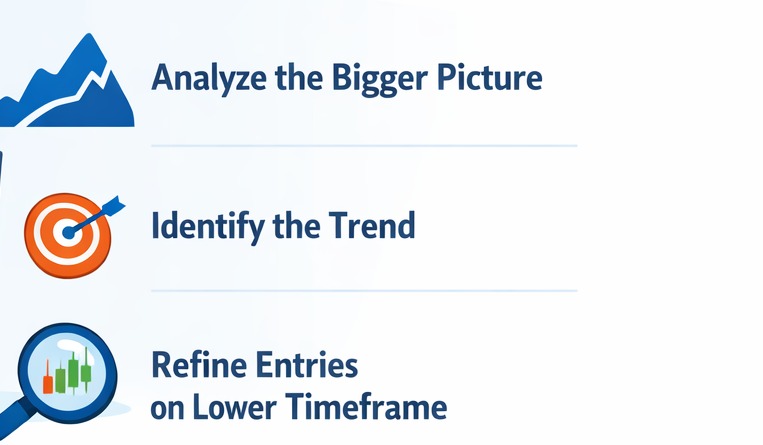
Top-down analysis means starting from the higher timeframe and gradually moving down to the lower timeframe to refine entries. It allows you to trade with direction instead of against it.
1.Start with the Higher Timeframe (Daily Chart)
Before thinking about entries, open the Daily chart. The daily timeframe shows the overall market direction and filters out unnecessary noise.
Your objective here is not to enter trades. Your objective is to understand structure.
- Is the market forming higher highs and higher lows?
- Is it making lower highs and lower lows?
- Is price trending or moving sideways?
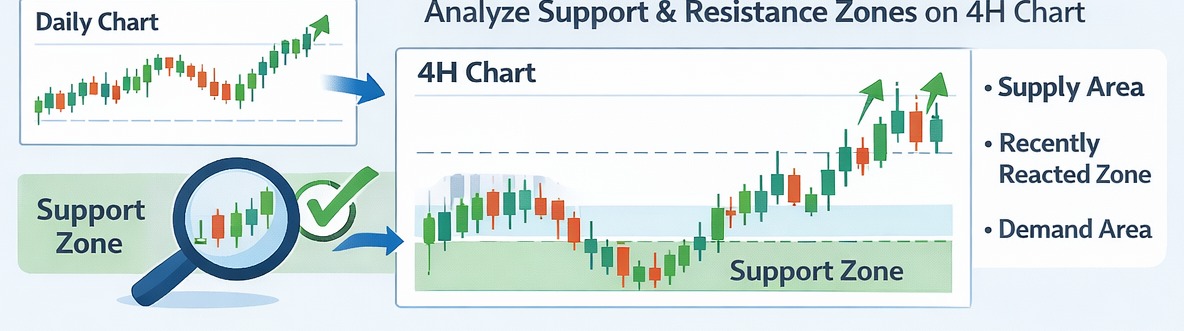
If the daily trend is bullish, focus mainly on buying opportunities. If it is bearish, look for selling setups. Many traders ignore this step and end up trading against the dominant trend, which often leads to unnecessary losses.
2.Move to the 4-Hour Chart
Once the higher timeframe direction is clear, move to the 4H chart to refine your analysis.
The 4H timeframe helps identify key zones such as:
- Support and Resistance
- Supply and Demand areas
- Recent strong reaction zones
For example, if the daily trend is bullish and price pulls back into a strong 4H support zone, that area becomes a high-probability location. Now you are not randomly buying — you are buying within a larger trend at a meaningful level.
This alignment between timeframes increases probability and reduces emotional decisions.
3.Refine Entry on Lower Timeframes (1H or 30M)
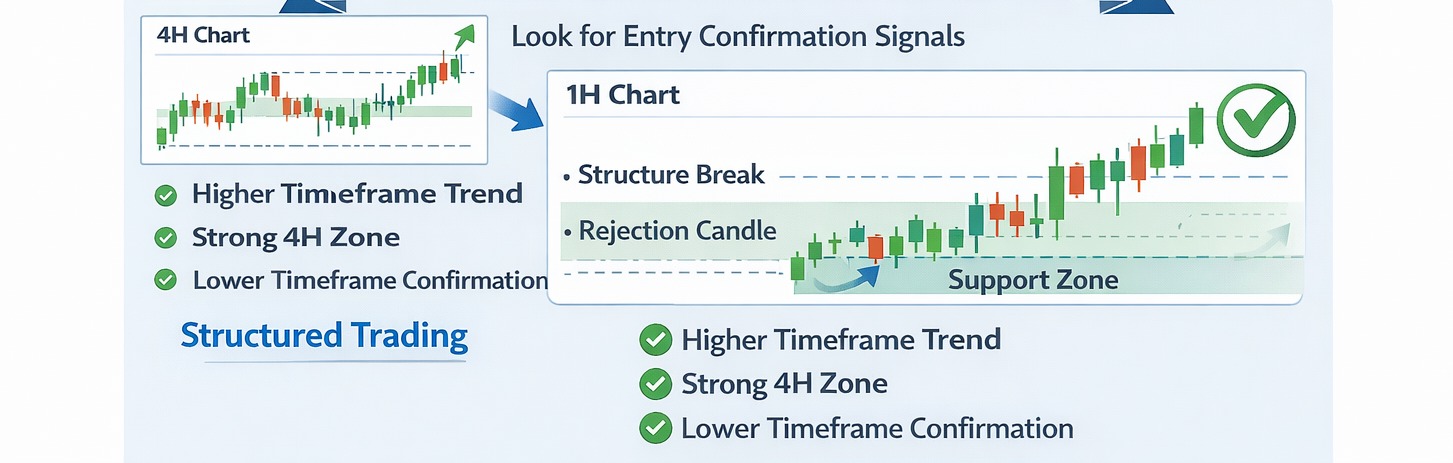
After identifying direction and key zones, move to a lower timeframe like 1H or 30-minute to wait for confirmation.
Instead of entering immediately, look for:
- Structure breaks in your trading direction
- Strong rejection candles
- Momentum candles supporting the trend
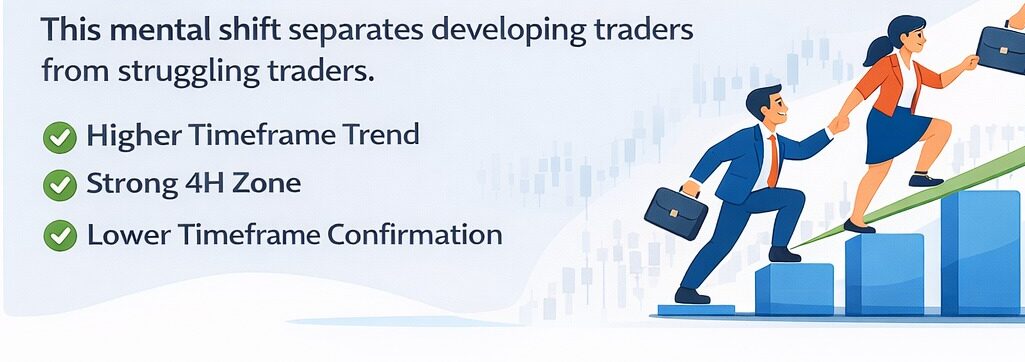
At this point, your trade is supported by:
- Higher timeframe trend
- Strong 4H zone
- Lower timeframe confirmation
This is structured trading, not emotional trading.
Why Most Traders Fail at Analysis
The most common mistake is starting from the lowest timeframe. Traders see a small breakout and enter immediately without knowing what the daily trend is doing.
Another mistake is overloading charts with too many indicators. Top-down analysis does not require complex tools. Clean charts with clear structure often perform better.
Simplicity improves clarity, and clarity improves decision-making.
The Psychological Advantage of Top-Down Analysis
Top-down analysis improves more than entries — it improves mindset.
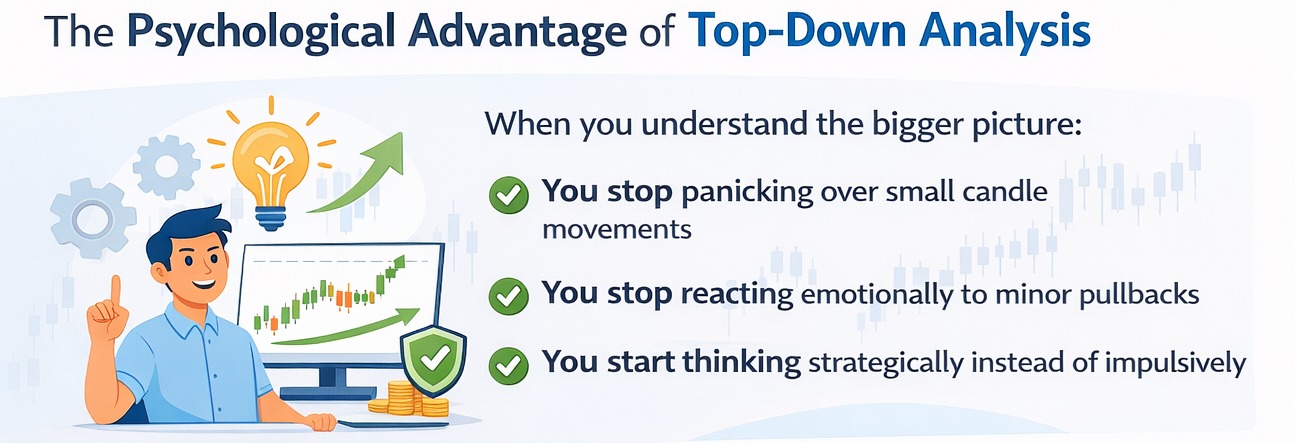
When you understand the bigger picture:
- You stop panicking over small candle movements
- You stop reacting emotionally to minor pullbacks
- You start thinking strategically instead of impulsively
This mental shift separates developing traders from struggling traders.
A Practical Routine You Can Follow
Before placing any trade, follow this simple routine:
- Open Daily chart – Mark overall direction
- Open 4H chart – Mark key support and resistance levels
- Open 1H chart – Wait for confirmation
Do not rush. The market will always provide new opportunities. Entering without structure reduces long-term consistency.
Final Thoughts
Forex trading is not about predicting every small movement. It is about understanding context and aligning with probability. Top-down analysis teaches you to see the market as a whole rather than reacting to individual candles. Over time, this structured habit can significantly improve trading consistency.
If you want to understand this concept in detail, read our guide on The Professional Traders Roadmap: How to Build a Clear Weekly Market Bias to learn how experienced traders plan their week with a structured approach.

