
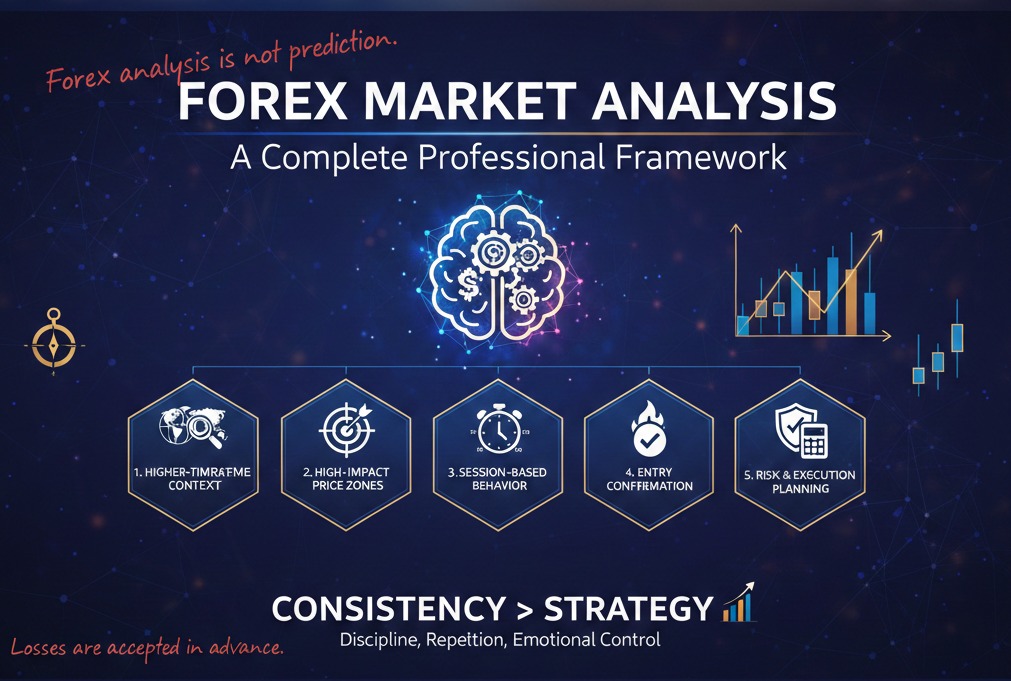
Forex market analysis is not about prediction. It is a structured filtering process that eliminates low-probability trades and highlights high-quality trading opportunities.
Professional traders follow a clear analytical framework before placing any trade. This approach removes emotion, improves consistency, and increases long-term performance.
Step 1: Higher-Timeframe Context
All professional analysis begins on higher timeframes such as the Daily and H4 charts. This provides clarity on:
- Overall market direction
- Key institutional price zones
- Long-term market bias
Trading without higher-timeframe context often leads to confusion, overtrading, and inconsistent results.
Step 2: Identify High-Impact Price Zones
Instead of drawing random lines, professionals focus on meaningful price areas such as:
- Strong support and resistance zones
- Previous major highs and lows
- Areas with sharp historical price reactions
These zones represent past institutional decisions. Price reacts to zones, not to precise lines.
Step 3: Session-Based Market Behavior
The forex market behaves differently across global trading sessions:
- Asian Session: consolidation and range formation
- London Session: expansion and directional movement
- New York Session: continuation or reversal of the London move
Professional traders align their analysis with session behavior to avoid low-volatility and low-probability conditions.
Step 4: Entry Confirmation
Professionals never enter trades blindly at predefined levels. They wait for confirmation such as:
- Strong rejection or momentum candles
- Market structure alignment
- Clear shift in momentum or price behavior
Confirmation helps reduce false entries and prevents emotional decision-making.
Step 5: Risk and Execution Planning
Before executing any trade, professionals define:
- Exact stop-loss placement
- Clear take-profit targets
- Fixed risk percentage per trade
Execution is mechanical, not emotional. Losses are accepted in advance as part of the trading process.
Why Consistency Beats Strategy
Most traders spend years searching for the “perfect strategy.” Professional traders focus on executing a single strategy consistently.
The real edge in trading does not come from complexity. It comes from discipline, repetition, and emotional control.
Forex trading rewards those who treat it as a structured business — not as entertainment or gambling.

