
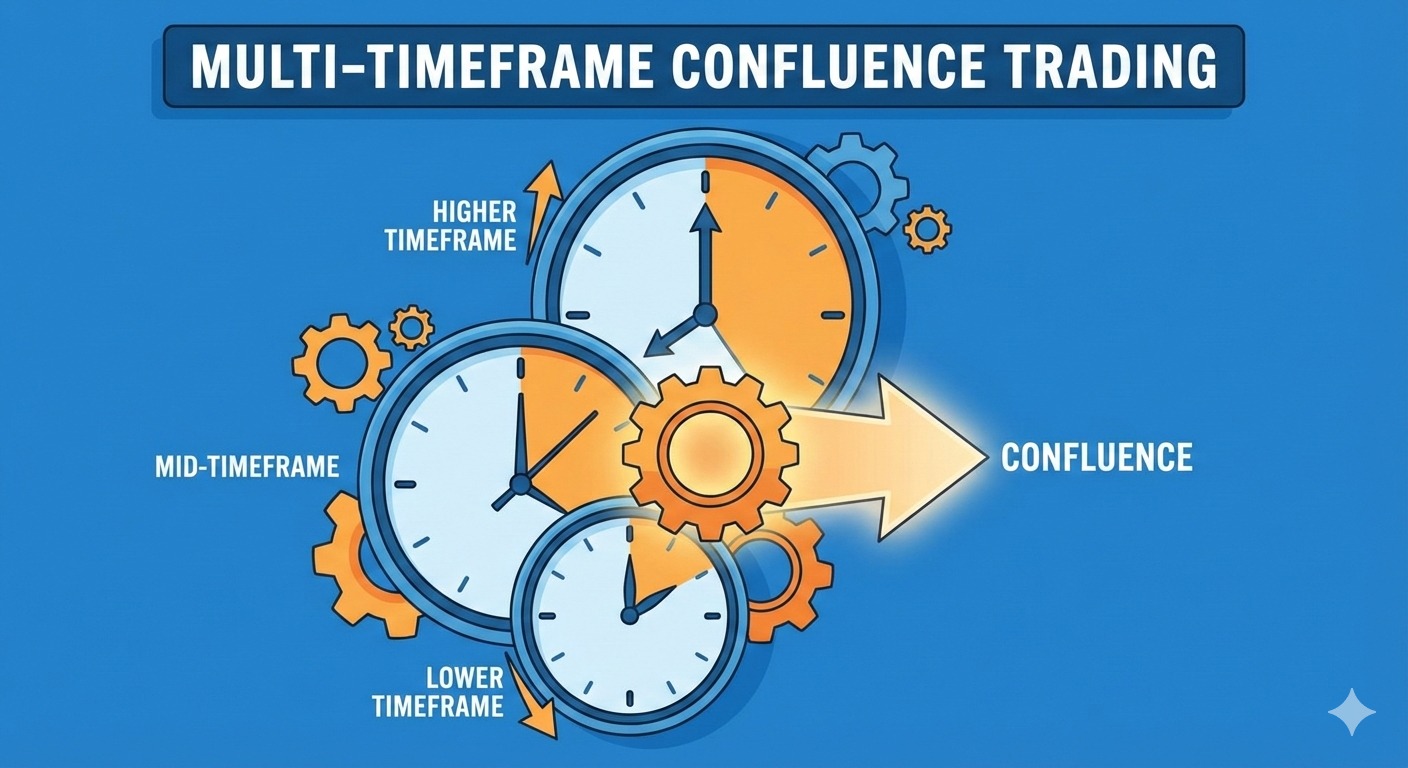
Consistent trading success rarely comes from one indicator or a single entry signal. Experienced traders build their edge by combining different layers of analysis. One of the most powerful approaches is multi-timeframe confluence trading — a strategy that aligns higher timeframe direction with lower timeframe precision.
Many retail traders focus on only one chart timeframe. This often leads to confusion because lower timeframes contain a lot of market noise. Professional traders reduce that noise by starting from the bigger picture and working their way down.
What Is Multi-Timeframe Confluence
Multi-timeframe confluence means analyzing the market from at least two different timeframes:
-
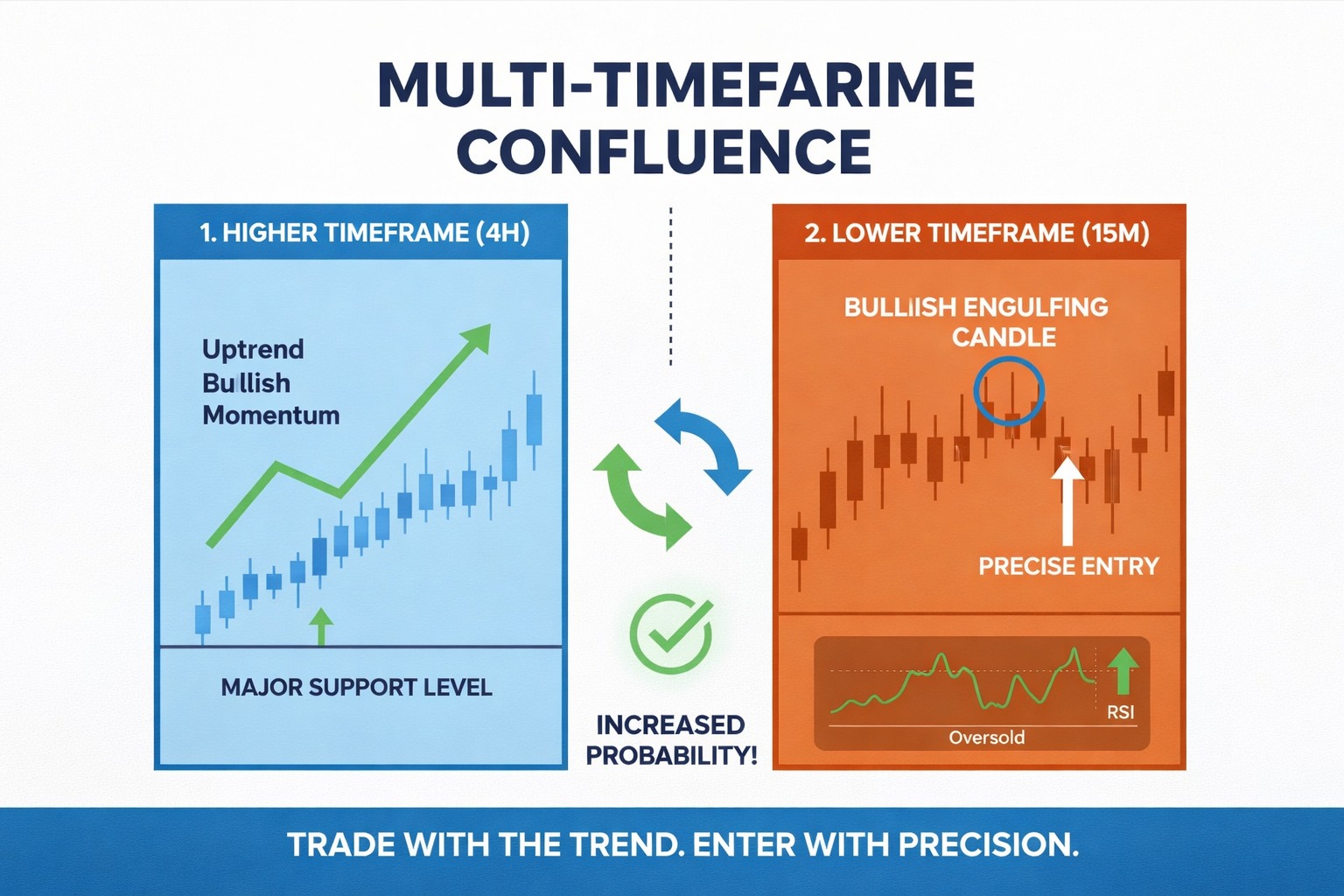
- A higher timeframe to understand the overall direction and structure.
- A lower timeframe to find precise entries with better risk control.
When both timeframes align in the same direction, the probability of a successful trade increases. This alignment is called “confluence.”
Step 1: Define the Higher Timeframe Bias
The first step is to establish directional clarity. Start with the Daily or H4 chart.
On the higher timeframe, identify the following:
- Overall trend direction (bullish or bearish)
- Major support and resistance levels
- Institutional supply and demand zones
- Market structure (Higher Highs & Higher Lows or Lower Highs & Lower Lows)
If the higher timeframe is forming Higher Highs (HH) and Higher Lows (HL), the market is bullish. In that case, you should mainly look for buying opportunities. If the structure shows Lower Highs (LH) and Lower Lows (LL), the bias is bearish, and selling setups become more favorable.
This step removes emotional decision-making and prevents random trading against the dominant trend.
Step 2: Wait for Price to Reach a Key Zone
Patience is one of the biggest advantages professional traders have. Instead of entering trades in the middle of a range, they wait for price to return to meaningful areas.
High-probability zones include:
- Demand zones during an uptrend
- Supply zones during a downtrend
- Previous breakout or retest levels
- Strong support or resistance areas
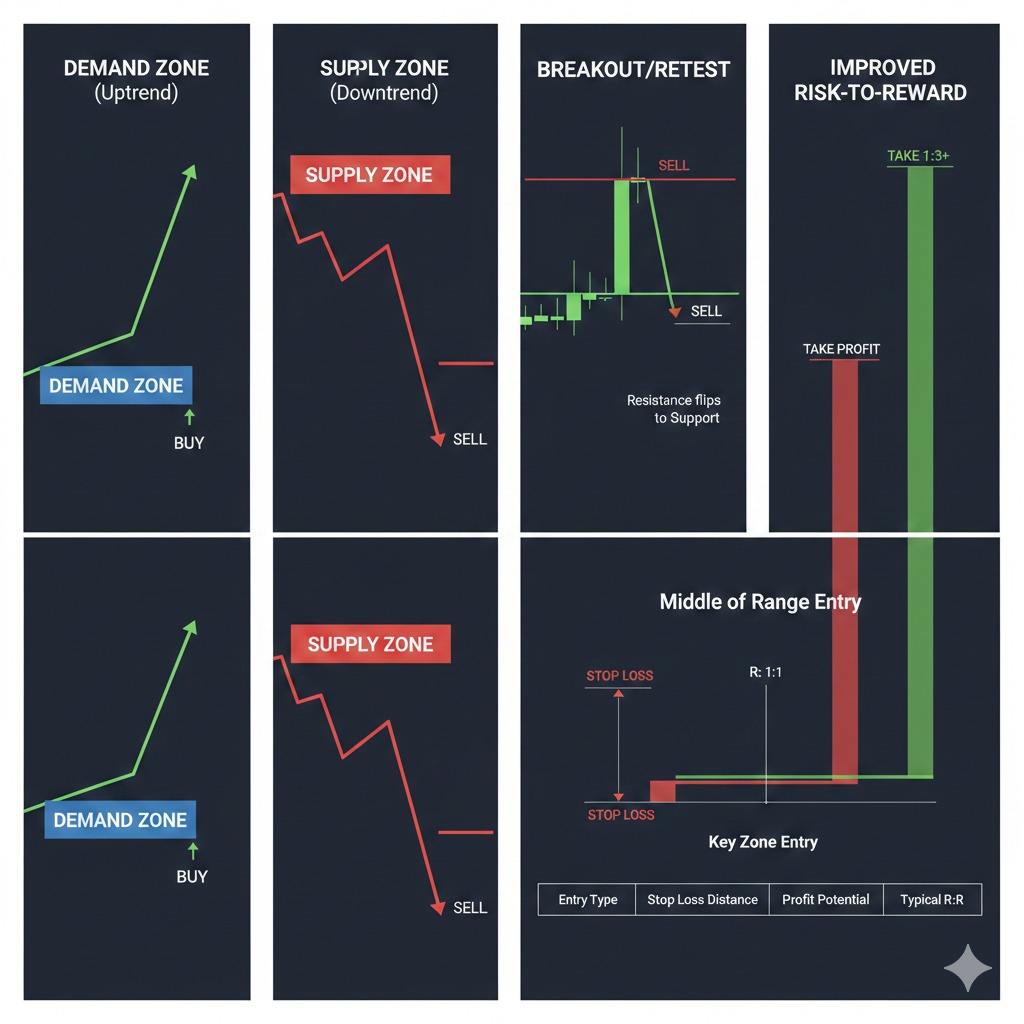
Entering trades at these levels improves risk-to-reward ratios and increases the probability of a favorable reaction. Trading in the middle of nowhere exposes you to unnecessary uncertainty.
Step 3: Drop to a Lower Timeframe for Entry
Once price reaches a key higher timeframe zone, move down to a lower timeframe such as H1 or M15.
On the lower timeframe, look for confirmation signals such as:
- Structure shifts (change in short-term trend)
- Strong rejection candles (pin bars, engulfing candles)
- Momentum confirmation in the direction of the higher timeframe bias
This approach allows you to place a tighter stop-loss while targeting larger moves in the direction of the dominant trend. The result is a stronger risk-to-reward setup.
Why Multi-Timeframe Confluence Works
This strategy works because it combines three powerful elements:
- Trend direction from the higher timeframe
- Institutional or key price levels
- Precise execution from the lower timeframe
Instead of guessing reversals or chasing price moves, you are waiting for alignment. When multiple factors point in the same direction, the probability of success improves.
Common Mistakes Traders Make
Even though this strategy is simple in concept, traders often make errors such as:
- Entering before price reaches a key zone
- Ignoring the higher timeframe trend
- Overtrading on very small timeframes
- Forcing trades without confirmation
Remember, advanced trading is not about taking more trades. It is about taking better trades.
Risk Management Still Matters
Even with strong confluence, no strategy guarantees 100% accuracy. Always manage risk carefully by:
- Risking a small percentage of your capital per trade
- Using logical stop-loss placement
- Aiming for favorable risk-to-reward ratios (1:2 or higher)
Consistency comes from discipline, not prediction.
Conclusion
Multi-timeframe confluence trading is a structured and professional approach to the markets. By starting with the bigger picture and refining your entry on a lower timeframe, you reduce noise and increase clarity.
High-quality setups with clear alignment will always outperform random entries. Focus on patience, confirmation, and structure — not frequency.
For more information on similar topics and advanced trading techniques, check out Why Risk–Reward Ratio Matters

