
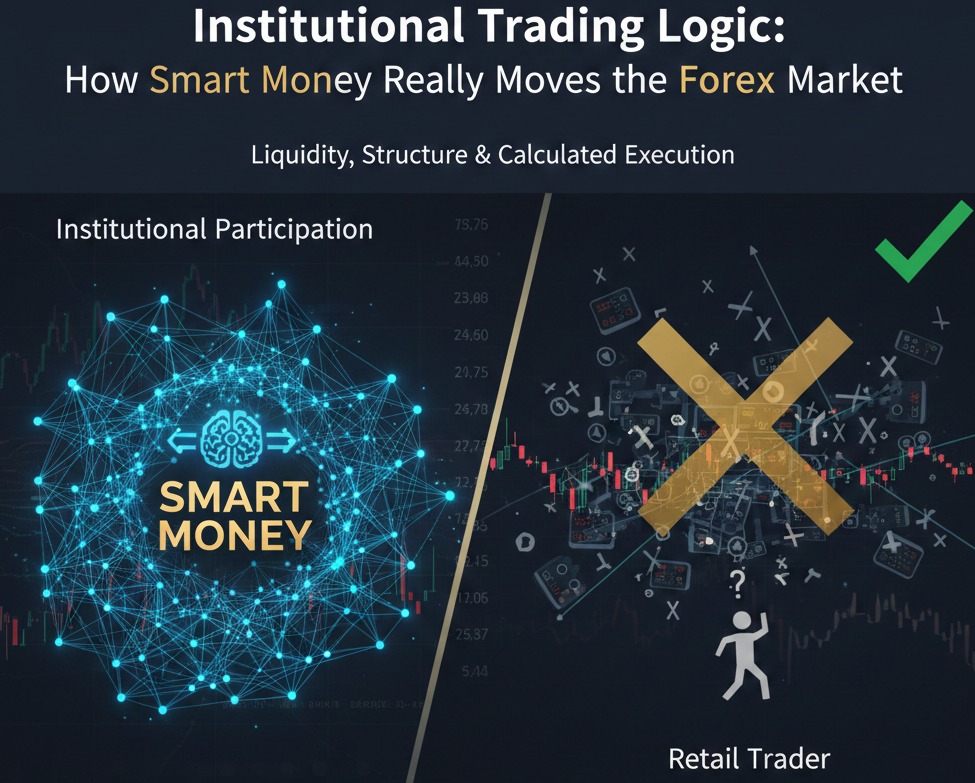
Most retail traders believe the forex market moves because of news events, indicators, or random volatility. In reality, price action is largely driven by institutional participation, liquidity flow, and structured execution.
Banks, hedge funds, and large financial institutions do not trade like retail traders. Due to their massive position sizes, they require liquidity and cannot enter or exit the market instantly. The market must first provide suitable conditions.
Why Liquidity Is the Core of Price Movement
Liquidity represents available buy and sell orders resting in the market. Retail traders typically place stop-loss orders in predictable areas, such as:
- Below recent swing lows
- Above recent swing highs
These zones naturally become liquidity pools. Institutional traders often move price toward these areas in order to:
- Trigger stop-loss orders
- Release large volumes of liquidity
- Enter positions efficiently with minimal slippage
This behavior explains why price frequently breaks key levels temporarily before reversing direction.
Market Structure from an Institutional Perspective
Market structure reveals which side of the market is currently in control. Institutions analyze structure to determine directional bias.
- Higher highs and higher lows indicate institutional buying pressure
- Lower highs and lower lows indicate institutional selling pressure
Professional traders never trade against established structure. Instead, they align their positions with the dominant flow of capital.
A break in structure does not automatically mean a reversal. It often signals potential redistribution, continuation, or a transition phase depending on liquidity behavior.
Why Indicators Fail at Advanced Trading Levels
Indicators are derived from price and therefore lag behind real market activity. Institutions focus on the cause of price movement, not delayed effects.
Over-reliance on indicators often leads to:
- Late trade entries
- Poor risk–reward ratios
- Emotion-driven decision making
Professional traders simplify their charts and focus primarily on:
- Clean price action
- Reactions at key liquidity levels
- Volume and volatility behavior
The Professional Trading Mindset
Institutional trading is patient, calculated, and selective. Not every trading day presents a valid opportunity.
Professional traders wait for:
- Price to reach high-probability zones
- Liquidity to be collected
- Market structure to align with bias
Advanced trading success does not come from frequent activity. It comes from waiting more than trading and executing only when conditions are optimal.

